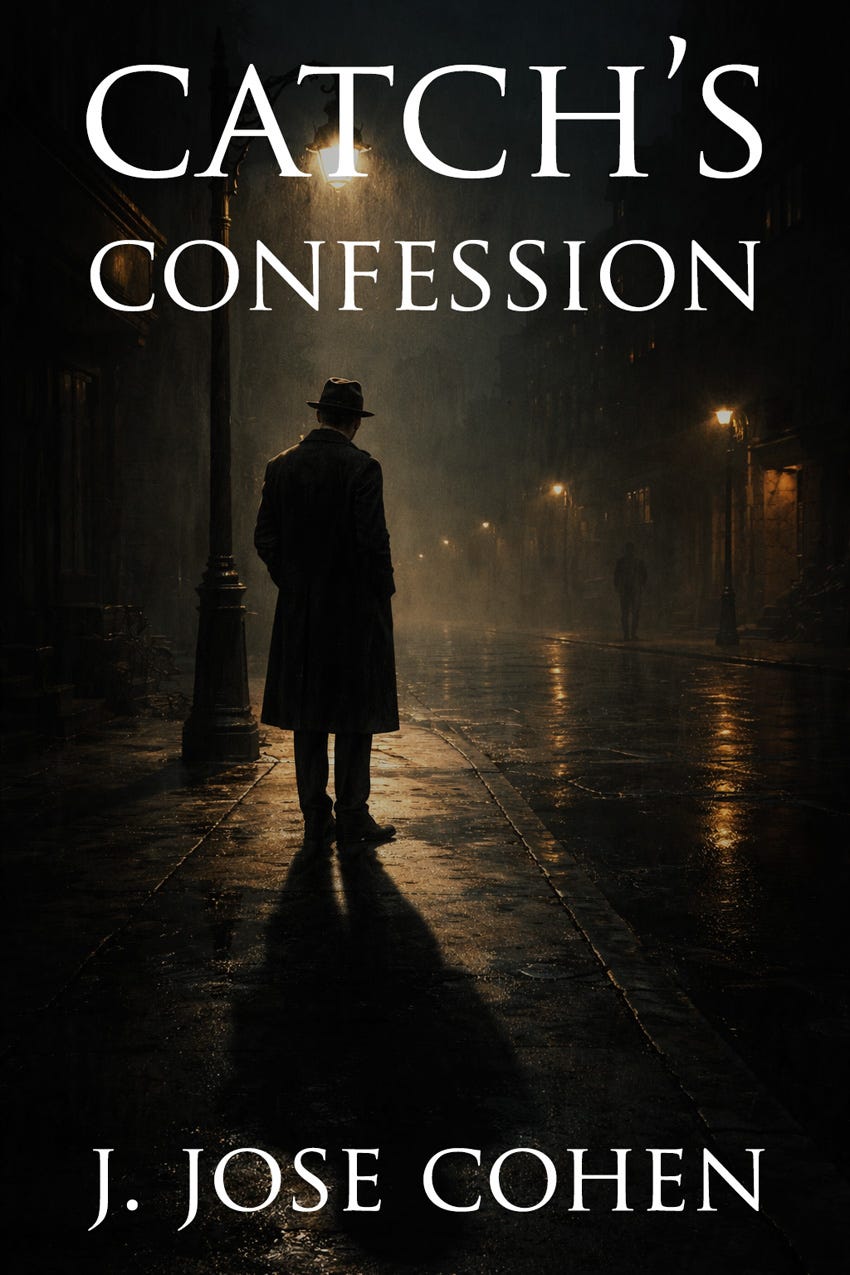
Catch did not sit. He remained standing at the edge of the kitchen table, palms resting lightly on the wood as if bracing against a mild tremor. “You’re describing coincidence as design,” he said. “Fear-induced cardiac failure. Guilt-induced collapse. Hysteria. I’ve seen all of it before.”
“Yes,” said Imogene.
The answer was not argumentative. It was acknowledgment. He did not like that. “You are four years old,” he said.
“Yes.”
“And you expect me to believe you are what? An auditor?”
She tilted her head slightly. “That is not inaccurate.”
Upstairs, Lyell’s laughter faltered into a soft muttering.
Catch drew his pocket watch from his vest. The face gleamed under the lamp. Twelve-forty-seven. He stared at the second hand. It ticked cleanly. He snapped the watch closed. “When does it end?” he asked.
Imogene considered the question as though he had asked about the weather. “It does not end.”
“With you?”
“With anyone.”
The kitchen felt smaller now. Not colder. Not darker. Just contained. “You chose this house,” Catch said.
“No.”
“The blueprints came to me.”
“Yes.”
“The article appeared that morning.”
“Yes.”
“That’s selection.”
“Yes.”
He paused. “But not yours.”
The lamp hummed faintly.
“Mr. Lamarck laughed,” said Catch. “He didn’t sound surprised.”
“No.”
“You spoke to him?”
“Yes.”
“When?”
“Before you did. Before you came to take me.” The words did not rise in volume. They did not need to.
Catch’s eyes sharpened. “And what did he say?”
“He said he had been waiting.”
The air in the room held still.
“For what?” asked Catch.
“For someone who would not freeze.”
Upstairs, a chair scraped faintly across wood.
Catch did not move. “He knew,” Catch said.
“He knows.”
“How long?”
“Long enough.”
“For what?”
“For the clock to finish its circle.”
Catch exhaled slowly. “So this was not random.”
“No.”
“And Dawkins.”
“No.”
“And Huxley.”
“No.”
“And Lyell.”
“No.”
“And Anderson.”
“No.”
“And me.”
“No.” The word landed cleanly.
Catch nodded once. “Why me?”
“You observe before acting.”
“That’s not virtue.”
“No.”
“It’s survival.”
“Yes.”
“And that qualifies me for what?”
“For remaining.”
Silence gathered around the table like a third presence.
“What happens if I walk out?” he asked.
“You may.”
“And then?”
“The clock will finish its circle.”
“And someone else?”
“Yes.”
“And you?”
“I will remain.”
The simplicity unsettled him more than accusation would have. “You don’t hunt,” he said.
“No.”
“You don’t pursue.”
“No.”
“You wait.”
“Yes.”
“For what?”
“For alignment.”
The word hung between them.
“You said nothing new happened at midnight,” Catch said.
“That is correct.”
“Then what changed?”
“You saw.”
He did not respond.
Upstairs, Lyell began whispering again. Fainter now. Less rhythmic.
“Mr. Lamarck,” Catch said carefully, “has he… remained?”
“Yes.” The answer was immediate.
Catch’s jaw tightened. “He is custodian?”
“Yes.”
“And he will continue?”
“For as long as he can observe without collapsing.”
“And then?”
“Another.”
Catch’s gaze drifted toward the stairwell. “And that is what being prepared?” he said.
“Yes.”
“For me.”
“Yes.”
There was no triumph in her tone. No cruelty. No satisfaction. Only record.
“You think I will stay,” he said.
“No.”
The answer surprised him.
“You will decide.”
“And if I choose not to?”
“You will still have chosen.”
He almost smiled. “That’s circular.”
“Yes.”
The lamp flickered once. Then steadied.
Catch straightened. “You believe I cannot escape this.”
“You may leave the house.”
“And the alignment?”
She did not answer.
He understood. Outside, a car passed on the road. Life continued. Ordinary. Unaffected. “You don’t need me,” he said.
“I do not.”
“Then why me?”
“You are already counting.”
The words struck him harder than accusation.
Upstairs, Lyell’s whispering ceased. The house felt still. Not haunted. Corrected.
Catch pulled the pocket watch from his vest and slid it back without looking at it. “If I remain,” he said slowly, “I decide when the clock is observed.”
“Yes.”
“I determine proximity.”
“Yes.”
“I control the variable.”
She tilted her head slightly. “You may believe that.”
He looked at her steadily. “And if I don’t remain?”
“The clock will still complete its circle.”
Silence.
“You don’t threaten,” he said.
“No.”
“You don’t persuade.”
“No.”
“You wait.”
“Yes.”
Catch pulled out a chair and sat. For the first time since midnight. He folded his hands loosely in front of him.
Upstairs, no sound came. The house felt balanced.
“You said Mr. Lamarck has remained,” he said.
“Yes.”
“For how long?”
“A long time.”
“And before him?”
“Yes.”
“How many?”
She did not answer.
The omission was answer enough. Catch nodded once. He looked at the lamp. Then at the wall behind her. Her shadow stood straight. Perfectly aligned. He glanced at his own shadow cast by the same light. It was upright. For now. “You will not age?” he said.
She did not answer.
“You will not weaken?”
She did not answer.
“You will not leave?”
“No.”
Catch inhaled slowly. Arithmetic. He had always removed variables. For the first time, he faced one that did not subtract. “You said I choose,” he said.
“Yes.”
“And that choice will be mine.”
“Yes.”
“And I won’t freeze?”
“No.”
Upstairs, the house remained silent.
Catch leaned back in his chair. “Very well,” he said. Not surrender. Not confession. Not repentance. Statement. Catch’s shadow shifts. Not dramatically.
The lamp hummed softly. And somewhere in the house, something settled into place.
Imogene did not smile. She did not move. She simply watched. And waited.